


Loyalty is builtin the recovery
Steve Jobs would not let the Apple Store say it loved its customers. The better story is further down: the customers who stayed were the ones whose problems were fixed fast. Most brands design for the day everything works, and leave the day it breaks to a script.

 Words:
This week Ron Johnson, the man who built the Apple Store, published a short piece in Fast Company ahead of his new book, Shop Different. Most of the attention will go to the anecdote in the headline. It is a good one. The more useful part is a number further down, because the number is what should change how a business behaves.
The anecdote first. Around 2001, Jobs asked Johnson to put the stores’ service philosophy in four words or fewer. Johnson came back with two: love customers. He meant it in the old sense, love as working for the good of another person. Jobs pushed back. Cupertino was not a place that said love. Could he use a different word?
Johnson landed on “enrich lives,” and turned it into steps staff could actually take: a warm welcome, questions to understand what the person needed, listening for the concern they had not said out loud, and a fond farewell.
A value has to be sayable
There is a small brand lesson in that exchange already. Jobs did not object to the idea. He objected to the word, because it had to be said by thousands of people, every day, without anyone rolling their eyes.
A service philosophy is a piece of writing with a very hard job. It has to be short enough to remember, plain enough to act on, and true enough that people will say it without feeling foolish. “Love customers” was right, and unsayable in that building. “Enrich lives” was sayable, and still pointed at the same thing.
Most company values fail at least one of those tests. They are too long to remember, too vague to act on, or too grand for anyone to say with a straight face.
The number that matters
In 2007, Apple Retail was one of the first retailers to adopt Net Promoter Score, the question that asks how likely you are to recommend something. The early results were what you would expect. Good experiences got recommended. Bad ones did not.
Then Johnson started doing something that was not a strategy. It just felt right. When a customer reported a bad experience, he wrote back to apologise and copied in the store leader. The store leaders followed up and fixed the problem, and because the boss was on the email, they did it straight away.
The customers whose bad experience was fixed quickly were, by Johnson’s account, seven times as likely to recommend Apple as customers who simply had a good one.
Delivering a great experience made customers happy. Addressing a failure made them loyal.
We would hold the exact figure loosely. It is one company’s internal read, recalled twenty years later in the run-up to a book launch, and the research on what is called the service recovery paradox is more mixed than a single number suggests. Recovery does not always beat getting it right, and nobody should start breaking things on purpose.
But the direction matches everything we have seen, and the reason is simple enough to trust. A smooth experience tells a customer that your process works. A problem fixed fast, by someone who clearly had the authority to fix it, tells them that you do. That is information they cannot get any other way.
You only find out what a business is actually like when something goes wrong.
The page most brands leave to the returns policy
This is the part most brands skip. They spend real money on the good path: the store, the website, the unboxing, the onboarding emails. They design the moment everything works.
The moment something breaks gets handed to a policy, a queue, a form, a script of approved phrases, and a staff member who is allowed to apologise and not allowed to do anything. Yet the complaint is the one moment a customer is paying full attention to how you behave. It is the most carefully read page of your brand, and most businesses have left it to whoever wrote the returns policy.
I learned a version of this at my agency back in New York. We built a full takeover campaign for a residential development in New Jersey: digital, out-of-home, the lot. The whole thing was space-themed, and one of the subway and NJ Transit car wraps carried a modified version of a line from Star Trek.
CBS, which owns Star Trek, sent a cease and desist letter. Our legal advice was that we could fight it, because the line had been changed enough. It was also that CBS was known for dragging these things out, and had far deeper pockets than we did.
So we did not fight it. We reprinted the posters at our own expense with one of the alternate lines from the campaign, and swapped them out quietly. What the client remembered afterwards was not the letter. It was how quickly it was handled, and that it never turned into bad press.
That is the seven-times effect, at the scale of one client.
None of it works if people are afraid
Johnson names the condition underneath all this, and it is the uncomfortable one: the whole thing depends on staff who are not afraid to make mistakes.
His example is from Apple SoHo in 2003. An author came in with a broken Windows PC and a book deadline. A specialist working from a sales script would have sold her a new computer. This one asked whether it would be easier to finish the book on one of the store’s machines while hers was repaired. She came in every day for a month.
There was no policy for that, and there could not have been. It happened because the specialist understood what the store was for well enough to improvise. The same freedom produced Personal Setup, which started with one store leader in Minnesota noticing that customers wanted their new computers set up for them, and ended up in every store.
Rules for the identity, judgement for the behaviour
Which puts this in a slightly awkward conversation with our last musing. There, we argued Coca-Cola was right to move its brand rules out of a PDF and into the design tools, so the rules get followed without anyone having to remember them. We still think that.
The two ideas fit together once you notice what each one governs. The identity should be locked: the colour, the type, the mark, the things that must look the same everywhere. The behaviour cannot be locked, because the moments that matter most are the ones no rule anticipated.
Rules for the things that should never change.
Judgement, and permission to use it, for everything that happens in front of a customer.
For a business that is not Apple
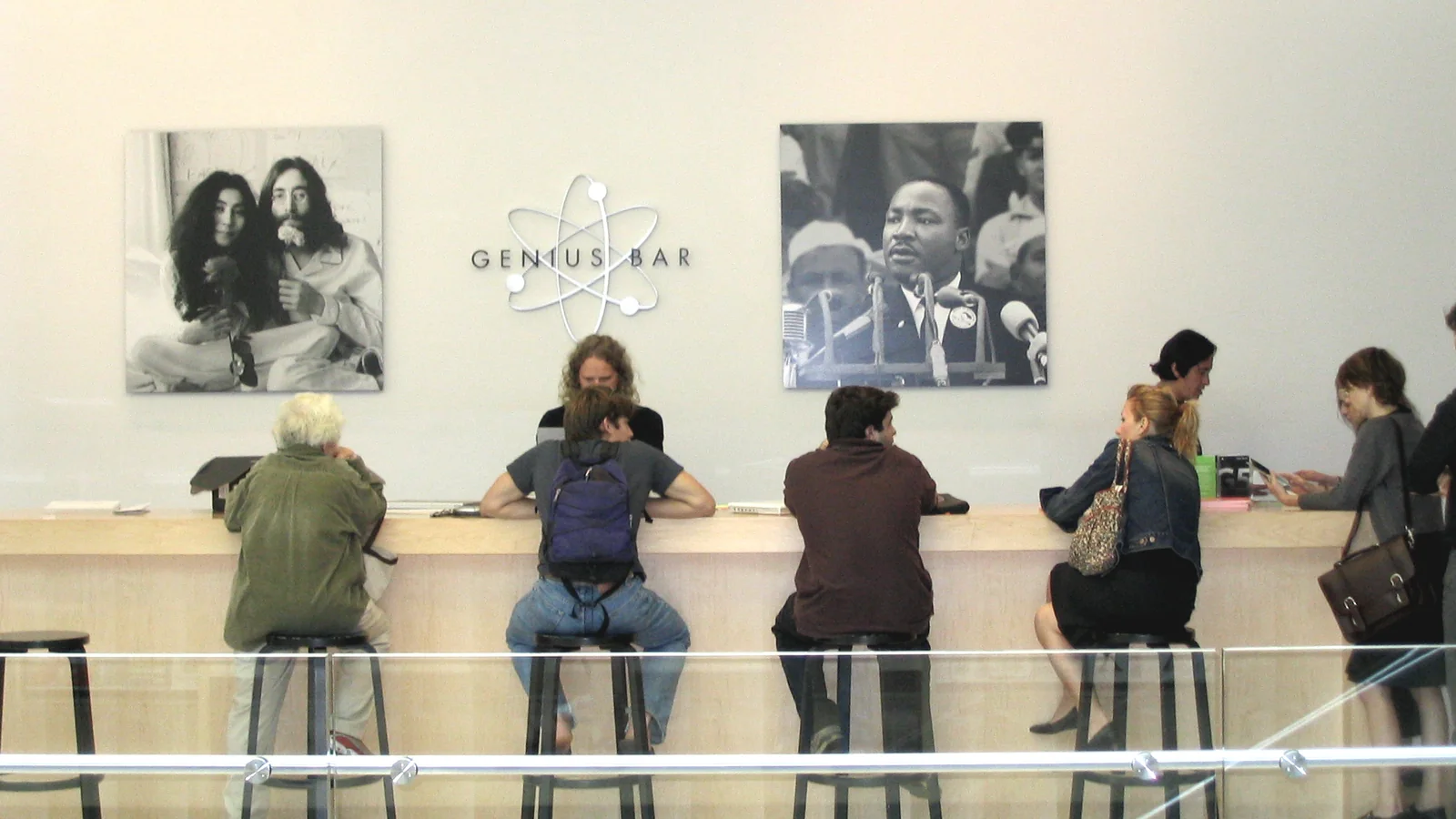
None of this needs a Genius Bar. Three things any business can do.
Write it down. Put your service idea in four words or fewer, and test it by whether your newest staff member would say it out loud.
Time the complaint. Count the hours between a complaint arriving and a person with the authority to fix it getting involved. Then cut that number, because speed is most of what the customer is judging.
Hand over some authority. Give the people closest to the customer something they can do without asking permission: a refund, a replacement, an hour of their time. Make it clear that using it and getting it slightly wrong is better than not using it at all.
Johnson ends his piece by saying love creates loyalty. We would put it in plainer terms, which seems fitting, given the story.
Customers stay because they saw what you did on the day it went wrong.